
Enterprise Community Platform Redesign
Modernizing the digital support ecosystem for a leading European Telecommunications Provider.
Role
Product Designer
Head of Design, UX strategy, IA
Scale
2M+ Users
Enterprise Scale
Impact
↓ Reduced
Support Escalations
00
Executive Summary
The legacy community platform created high operational load and poor self-service outcomes. Users couldn’t find reliable answers, moderators managed repetitive questions manually, and engineering spent cycles patching UI inconsistencies instead of building value.
I led the UX redesign end-to-end, establishing a scalable discovery framework, rebuilding navigation and filtering logic, and defining the technical boundaries needed for predictable delivery. By sequencing complexity, limiting custom UI, and introducing structured QA and dev-ready packages, we accelerated engineering throughput while significantly improving findability, clarity, and platform consistency.
The redesign strengthened user trust, reduced friction in contribution flows, and stabilized the component ecosystem—setting the foundation for future growth and feature expansion.

01
The Challenge
Understanding the problem space and its business impact
The community platform functioned as a critical, high-stakes support channel for a major telecommunications enterprise with 2M+ active users.
Instead of relieving operational pressure, it fragmented knowledge across search, topics, and posts.
Users failed to find reliable answers, moderators handled repeated questions manually, and engineering was forced to patch UX inconsistencies instead of advancing core functionality.
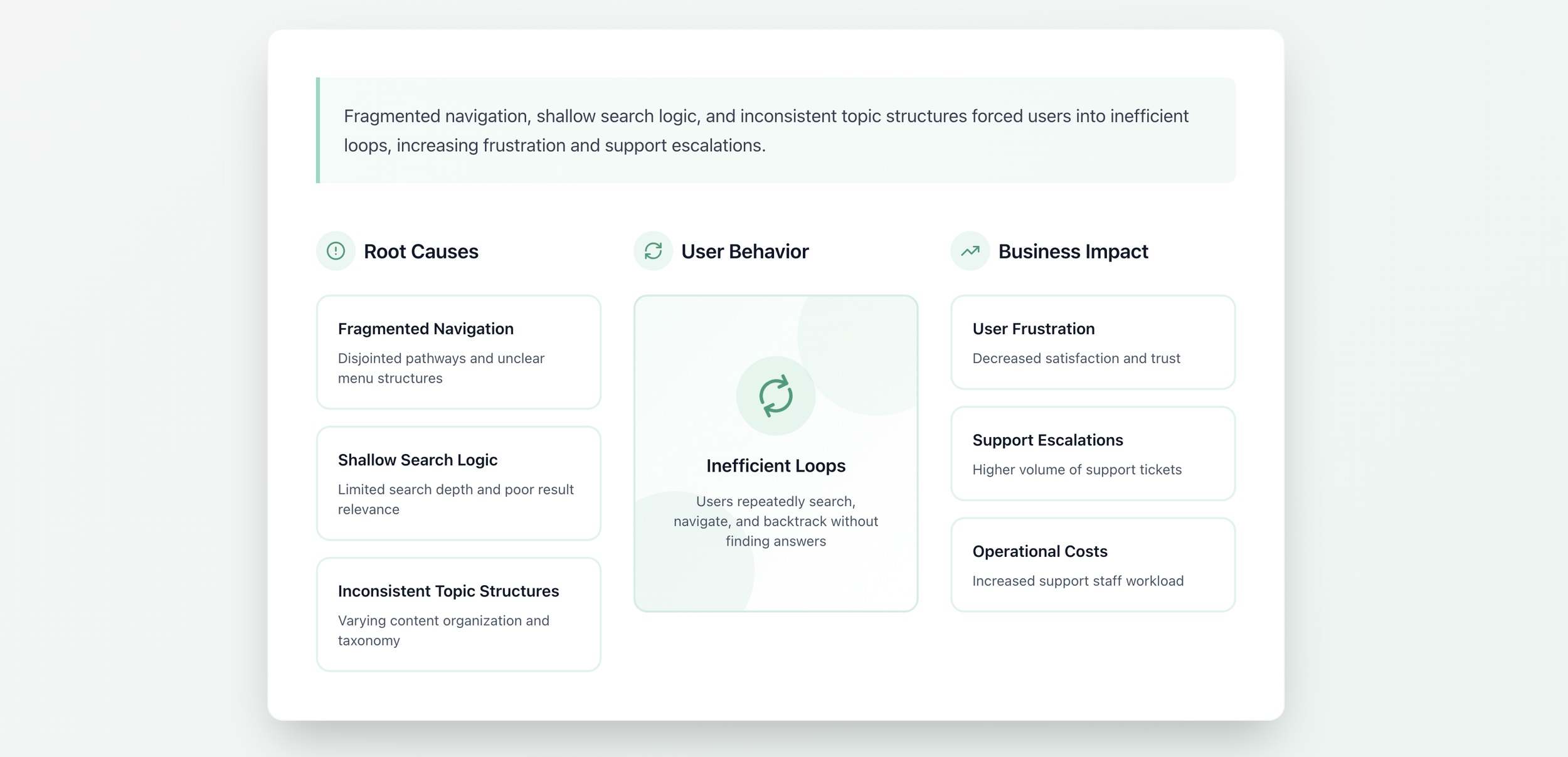
Fragmented User Experience
02
The Goal
Establish a scalable discovery framework that reduces load on support teams, accelerates problem resolution, and strengthens user trust across high-volume journeys.
Reduce Friction
Introduce predictable navigation flows that lower cognitive load and prevent dead ends.
Improve Findability
Enhance search and structured taxonomy to help users discover relevant answers faster.
Enhance Reliability
Prioritize validated answers and official solutions to build user trust.
Scalable Foundation
Establish a long-term foundation that supports future product growth and feature expansion.
03
My Role
Head Designer — driving UX direction, system logic, and execution quality.
🎯
Strategic Direction
Defined UX strategy and system logic for the entire platform redesign.
👥
Team Oversight
Directed a team of three designers by providing UX guidance, aligning outputs, and safeguarding cross-platform consistency.
⚡
Quality Ownership
Managed weekly dev-ready deliveries and served as the primary engineering bridge.
I owned the end-to-end UX and UI direction for the redesign, working closely with our Design Lead for high-level strategic alignment while leading the full design workstream. My focus was to ensure the platform's experience was coherent, scalable, and easy to implement across a complex system with many use cases.
04
Discovery & Alignment
Understanding the current state to build a clear foundation
Platform Audit
Audited the existing platform to identify UX gaps, friction points, and technical constraints.
Priority Definition
Worked with stakeholders to define priorities and success criteria for the redesign.
Journey Mapping
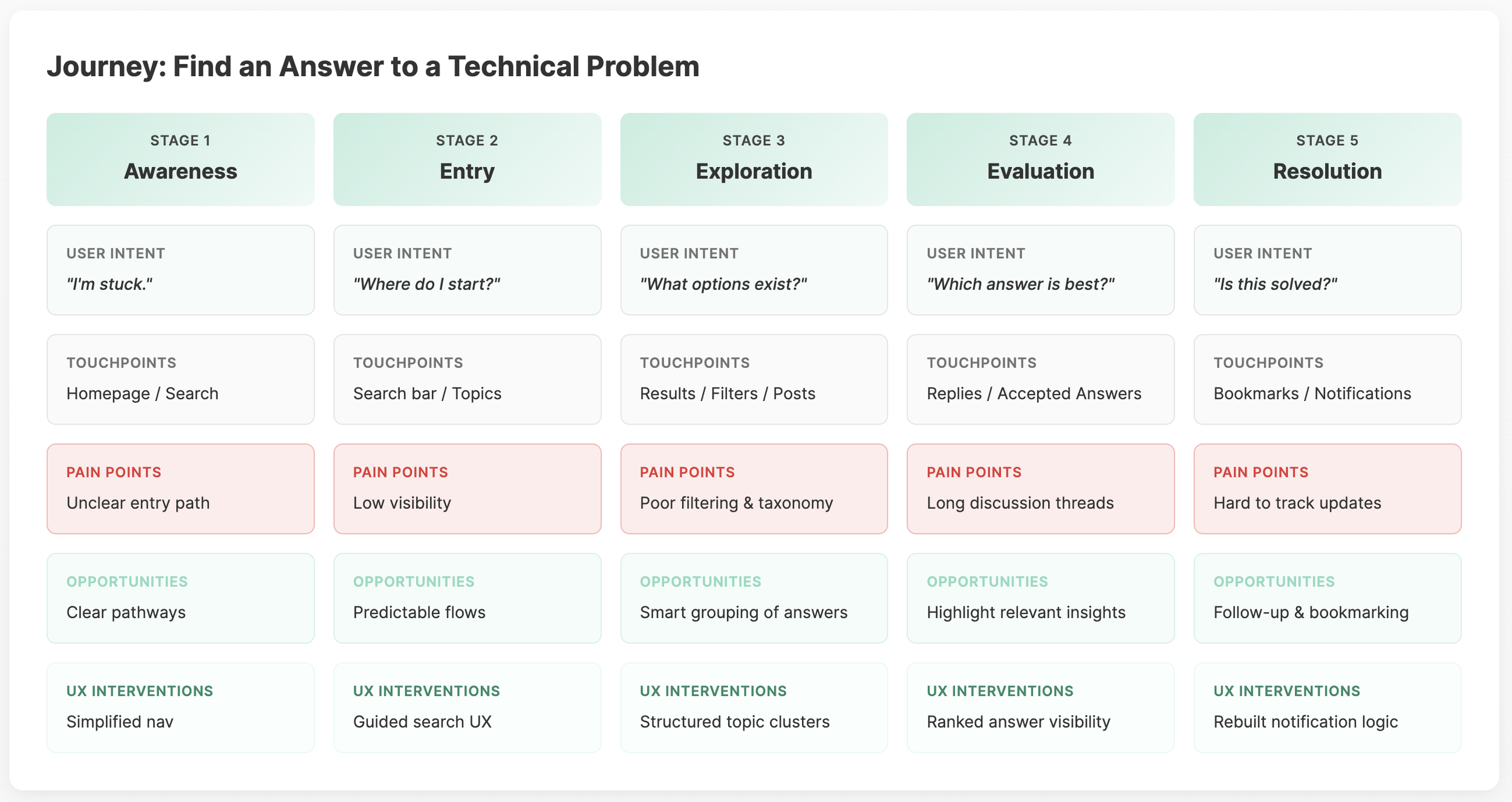
Mapped priority user journeys to pinpoint experience inefficiencies and define high-impact intervention areas.
Feasibility Assessment
Clarified technical feasibility and dependencies with external development teams.
Validation Approach
Validation was driven by domain stakeholders in daily contact with community superusers, ensuring design decisions were grounded in real platform behaviors.
Iterations were evaluated through rapid feedback loops with moderators, support teams, and product owners, who directly monitored user pain points and recurring friction patterns. This approach enabled practical decision-making in the absence of direct user testing and helped prioritize solutions that addressed real-world problems.
User Journey Map
We mapped the core "Solution Finding" journey to identify critical pain points and define targeted UX interventions for each stage.
05
Strategy & Design Approach
Driving clarity, consistency, and scalable execution.
To keep delivery predictable while simultaneously improving experience quality, I made several structural decisions that balanced usability, feasibility, and speed.
Experience-First Architecture
Rebuilt global navigation and topic structures to reduce user friction and simplify the contribution flow, ensuring a seamless experience across all responsive breakpoints.
Progressive Disclosure for Filters
Reduced cognitive load by surfacing only essential filters upfront and placing advanced controls behind a secondary layer. This balanced speed for everyday users with precision for experts.
Multi-Persona Experience
Designed layered interaction models to balance competing needs—fast discovery for Everyday Users, advanced controls for Heavy Users, and efficient moderation flows for Admins.
MVP Tolerances for Delivery Speed
Prioritized structural clarity and core functionality over pixel-perfect visuals where delays didn't result in a measurable increase in user value.
Limit Custom UI
Leveraged existing components wherever possible to reduce implementation time and ensure long-term maintainability. Custom solutions were only approved when testing demonstrated a measurable lift in task efficiency.
Experience-First Architecture
Progressive Disclosure for Filters
06
Execution & Collaboration
Driving predictable delivery in a high-constraint environment
To keep a steady pace and protect quality, I worked closely with product, engineering, and content stakeholders. We set up a clear working process that moved designs from exploration → review → development smoothly, even when requirements changed or technical limits appeared.
Weekly Dev Packages
Dev-ready deliveries containing responsive layouts, interaction states, and functional parameters. This reduced ambiguity and enabled engineering to implement without rework.
Design QA Pipeline
Visual and behavioral checks embedded into every release cycle. This ensured parity between design intent and what shipped in production.
Continuous Alignment
Rapid micro-loops with PMs, engineers, and community moderators. These sessions surfaced edge cases early and maintained clarity across the roadmap.
Trade-Off Management
Backend indexing constraints limited our ability to launch multi-layer filtering at full fidelity. To maintain momentum, I split the solution into two releases:
Step 1: deliver high-value service categories early,
Step 2: expand to device-level tags once indexing matured.
This preserved user value and kept engineering velocity on track.
Team Enablement
Our delivery cadence required weekly dev-ready handoffs with tight feedback loops. When a team member struggled with this agility, I adjusted our planning, paired with them on difficult edge cases, and redistributed complexity.
This allowed us to maintain speed without burning out the team.
07
Key Solutions Delivered
Transforming platform experience through strategic design interventions
Solution 01
Task-Oriented Navigation
We replaced the fragmented structure with a streamlined global navigation and consistent topic taxonomy. This reduced cognitive load, accelerated content discovery.
Solution 02
Search Experience Upgrade
I redesigned the full search flow query entry, filters, results layout, and empty states, enabling users to surface relevant answers faster and reducing support escalations.
Solution 03
Contribution Flow Redesign
We simplified how users create new posts, reply, and follow discussions. The new flows offer clearer guidance, fewer steps, and predictable behaviors across devices.
Solution 04
Reintegration of Missing Features
Rebuilt bookmarking, user dashboards, notifications, and visibility logic from the ground up, introducing features progressively to mitigate risk.
Solution 05
Adaptive UI Components
Where the client’s guidelines lacked necessary elements, I designed custom components—cards, filters, tabs, form fields—to enable fast engineering delivery while keeping the overall interface cohesive.
Solution 06
End-to-End Responsive System
I ensured every page and flow worked seamlessly across mobile, tablet, and desktop, accommodating both light and dark themes. This significantly improved accessibility and reduced UX debt across the platform.
08
Impact & Outcomes
Real improvements validated through stakeholder feedback, heavy user insights, and engineering delivery results.
Navigation clarity
↑ Improved
Users located relevant topics more easily due to a unified navigation and simplified entry points.
Search efficiency
↑ Improved
Refined IA, filtering, and result states allowed heavy users to surface existing answers before escalating to support.
Developer rework
↓ Reduced
Weekly dev-ready packages, responsive specs, and explicit component states lowered implementation ambiguity.
Contribution friction
↓ Reduced
Clearer guidance, stable publishing flows, and predictable content visibility increased post completion.
Platform consistency
✓ Stabilized
Shared components, unified patterns, and cross-device logic reduced UI discrepancies and edge case escalations.
User confidence
✓ Strengthened
Feedback from moderators and community stakeholders reflected fewer “platform frustration” complaints and increased re-engagement from heavy users.
Conclusion
This project transformed an underperforming, fragmented community into a modern, intuitive, and scalable platform. By driving UX strategy, owning execution, and maintaining strict alignment across design and engineering, I helped the client re-establish trust with their users and create a roadmap-ready ecosystem for ongoing digital growth.
09
Team & Acknowledgements
Collaboration that made transformation possible
Delivering a transformation of this scale is never a solo endeavor. I want to give a huge kudos to the core design squad, whose resilience and attention to detail brought the vision to life across thousands of screens.
Additional screens are available via screen sharing due to confidentiality constraints. Happy to walk you through them.